Introduction
Stage 13 of the 2025 Vuelta a España is set to deliver fireworks as the race heads into Asturias and tackles the feared Alto de l’Angliru. Known as the Asturian Monster, the climb has become the Vuelta’s signature ascent since its introduction in 1999. With its brutal ramps and legendary history, the Angliru is not just a stage finish. It’s a battlefield that has defined champions and destroyed favorites.
The Anatomy of a Monster
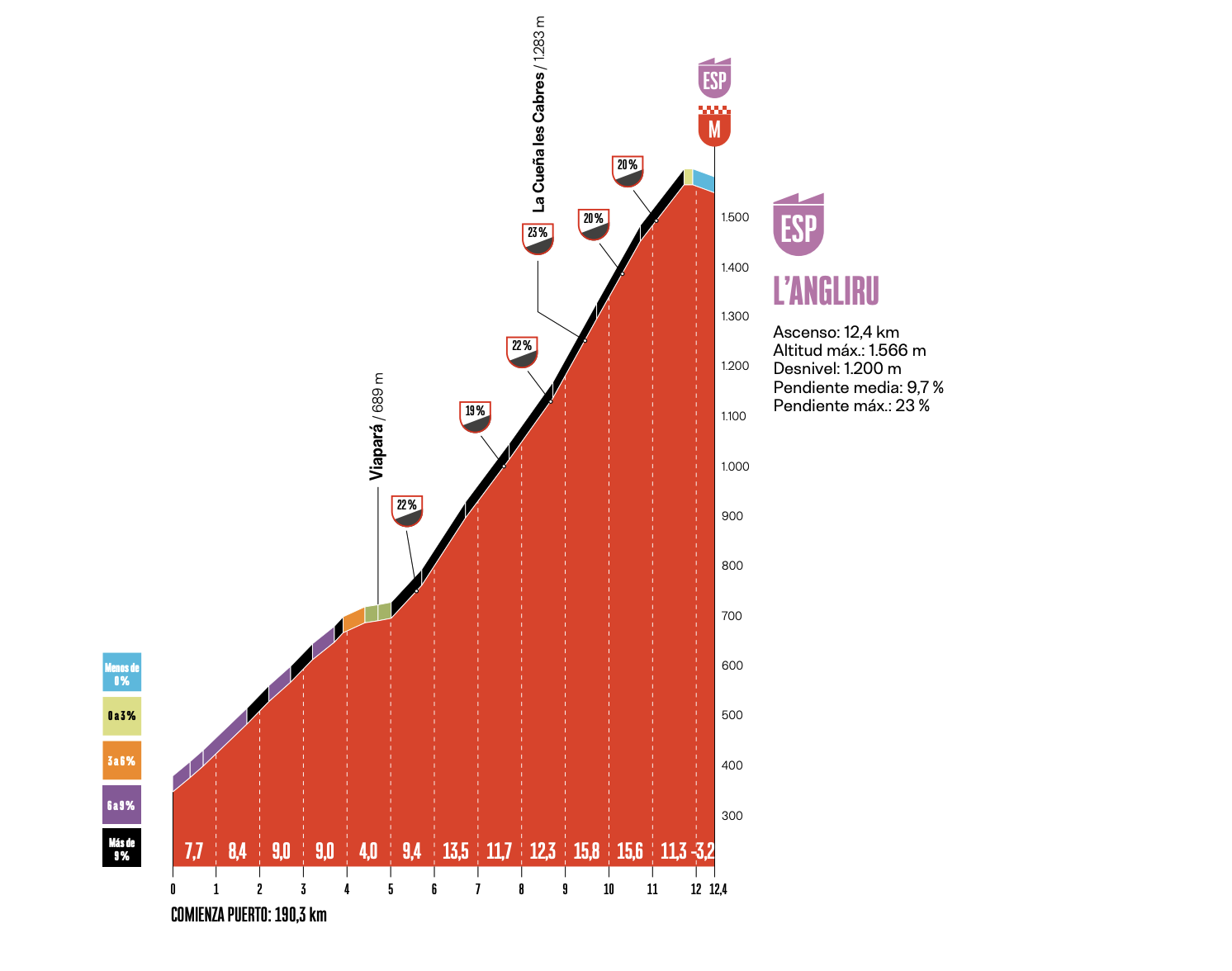
The Alto de l’Angliru is one of the steepest and most punishing climbs in professional cycling. Stage 13 stretches over 202.7 km with 3,964 meters of elevation gain, finishing on its slopes.
- Length: 12.8 km
- Average gradient: 10.7%
- Max gradient: 23.5% at Cueña les Cabres
- Elevation gain: 1,248 m
- Summit altitude: 1,565 m
The climb unfolds in two acts. The first six kilometers average a challenging yet manageable 7–8%. But after the Mirador del Pando, the road narrows and the monster reveals itself: walls above 20% that force riders to zig-zag simply to stay upright. The Cueña les Cabres, or Goat Path, is the most infamous ramp of all.

A Modern Classic: History and Purpose
The Angliru made its Vuelta debut in 1999, designed to give Spain a rival to cycling’s most iconic climbs—Alpe d’Huez, Mont Ventoux, and the Mortirolo. It immediately lived up to its billing.
- 1999 winner: José María Jiménez, christening the Angliru with Spanish flair.
- Other champions: Gilberto Simoni, Roberto Heras, Alberto Contador, Hugh Carthy, Primož Roglič.
- 2002 chaos: Rain turned the climb into mayhem, with stalled team cars blocking the road. Furious, David Millar abandoned just meters from the finish line.
The Angliru quickly earned its reputation as the stage that can shatter the General Classification.
Strava Records and Digital Legacy
Beyond race history, the climb has built a reputation in the digital age.
- In 2017, Steven Kruijswijk (Jumbo-Visma) set the Strava KOM during a Vuelta stage, while Alberto Contador sealed his final career victory.
- Since 2023, that record fell to Sepp Kuss (Visma-Lease a Bike), who climbed the Angliru in 43:03 minutes, more than a minute faster than Kruijswijk. That same week, Kuss went on to win the Vuelta a España 2023, cementing his place in history.

Rider Perspectives: Fear and Glory
The Angliru has always inspired both fear and awe.
- “Impossible.” — Leonardo Piepolo, after a 1999 recon ride.
- “Quicker on foot.” — Anonymous rider, reflecting on the gradients.
- “Even the winner goes up in slow motion. There’s no attacking—everyone climbs as best he can.” — Former French pro.
And yet, the summit brings a reward like no other. Riders speak of emerging from the fog into clear skies at the top, greeted by sunshine after the darkest suffering.
Stage 13 in 2025: What to Expect
Placed midway through the Vuelta, Stage 13 is a red jersey sorting day. With nearly 4,000 meters of climbing, the GC contenders will not be able to hide. The Angliru will expose weaknesses and crown the strongest climber.
Stage 13 is guaranteed to shake up the GC. If you’re playing along, make sure to check my Vuelta 2025 Fantasy Guide for team picks and rider strategies.
Names to watch include Jonas Vingegaard, João Almeida, Thomas Pidcock, and other red jersey hopefuls. Expect fireworks, survival tactics, and possibly decisive time gaps.
Angliru vs. Other Giants
How does the Angliru compare?
- Alpe d’Huez: 13.8 km at 8.1%
- Mont Ventoux: 15.7 km at 7.5%
- Mortirolo: 12.6 km at 10.5%
- Angliru: 12.8 km at 10.7%, with ramps above 20%
On paper, it is steeper than all three. In reality, its reputation for brutality is unmatched.
Cycling Tourism: How to Ride the Angliru
For amateur cyclists, the Angliru is a bucket-list climb.
- Start point: La Vega de Riosa, Asturias.
- Road condition: Narrow, steep, often damp.
- Recommended gearing: Compact crankset (34t) with at least a 32t cassette.
- Tips: Pace yourself early—after the Mirador del Pando, the gradients spike brutally. Bring layers; the summit weather shifts quickly.
Conquering the Angliru is not just a ride, it’s a badge of honor.
Conclusion
The Alto de l’Angliru is more than a mountain. It is the soul of the Vuelta a España. With its savage gradients, legendary drama, and decisive role in shaping champions, it embodies the very essence of Grand Tour cycling. Stage 13 of the 2025 Vuelta a España will once again prove why the Angliru remains the most feared and revered climb in Spain.
For a full overview of every team and bike on the start line, visit the Vuelta 2025 Teams, Riders & Bikes Hub